
You have 0 items in your cart

Etsko Schuitema is the founder of the Schuitema Group, a consultancy dedicated to the enhancement of Human Excellence – based on the Care & Growth model. Born into a mining family in South Africa, Etsko grew up in Johannesburg. After doing an Honours degree in Social Anthropology at the University of the Witwatersrand, he got a job as a researcher with The Chamber of Mines of South Africa’s Research Organisation.
Article by Etsko Schuitema
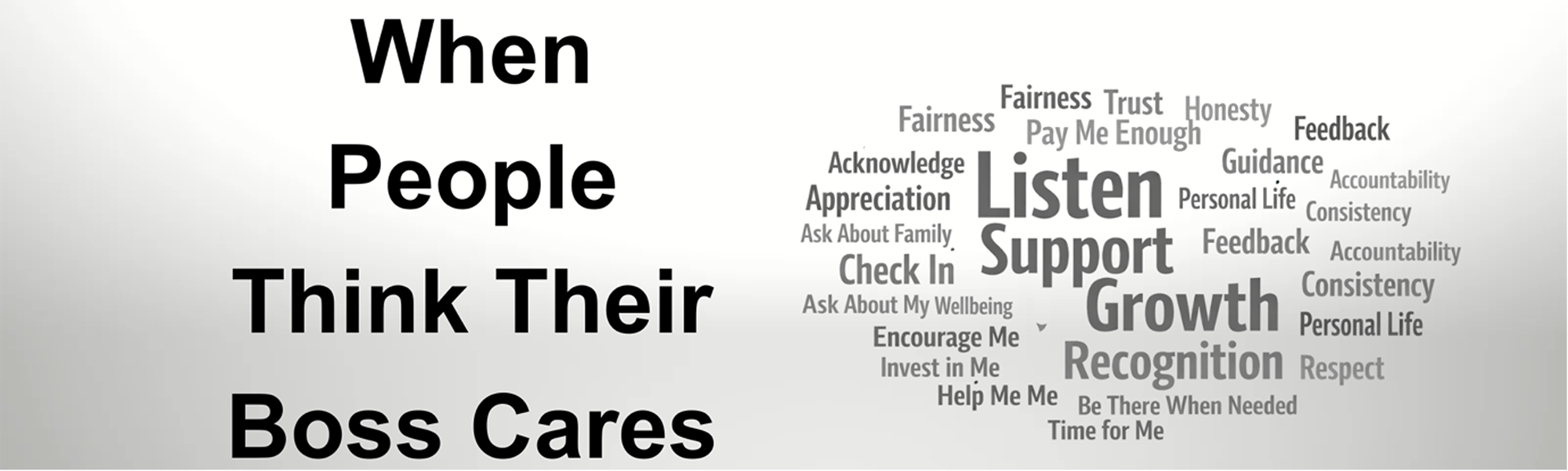
On 23 April we launched a Mentimeter survey on LinkedIn on how people knew their boss cared and 68 people responded. What was remarkable about these responses was not their diversitry but their convergience. Beneath the many individual expressions lies a remarkably consistent picture of what people interpret as care from their boss. The data does not describe perks, policies, or programmes. It describes a relationship.
At the most basic level, people experience care when they are heard. The single most frequent response—by a clear margin—is “listen.” Not performative listening, not waiting to respond, but genuine attentiveness: “listen to me,” “listen to my ideas,” “listen attentively,” “really hears my problems.” This is not a communication technique; it is an orientation. To listen is to suspend one’s own agenda long enough for the other person to exist in full. Many of the other responses reinforce this: “pay attention,” “eye contact,” “making time for me,” “talks to me not email.” Care begins where the subordinate experiences that they are not an interruption to the boss’s priorities—they are the priority, at least for that moment.
Closely alongside listening sits support, the second most recurring theme. But again, support is not abstract. It is deeply contextual and often revealed under pressure: “helps when I’m struggling,” “support during difficulty,” “has my back when it’s tough,” “shielding me,” “stand up for me.” Care is not proven in stable conditions; it is proven when something is at stake. The boss who protects, who carries some of the burden, who does not abandon the subordinate when things go wrong—that is the boss who is experienced as caring. This aligns with a deeper truth: care is not sentiment, it is cost. It is what the leader is willing to risk, absorb, or carry for the sake of the other.
A third cluster of responses centres on growth. Employees repeatedly pointed to “support my growth,” “be invested in my growth,” “help me grow,” “pushes me into new projects,” “teaches me things,” “provides guidance.” Care, in this sense, is not comfort. It is development. People feel cared for when someone is actively involved in their becoming—when the boss is not merely extracting performance but building capacity. Importantly, this includes both encouragement and correction: “constructive feedback,” “corrects me if I am wrong,” “holds me accountable on mistakes.” The presence of accountability in the data is significant. It suggests that people do not experience accountability as uncaring when it is delivered within a relationship of support and growth. On the contrary, the absence of accountability may signal indifference.
Another powerful theme is recognition and appreciation. Responses such as “acknowledge,” “appreciate my efforts,” “recognises my achievement,” “says thank you,” and “notices my effort” appear repeatedly. At one level, this is simple: people want to be seen. But at a deeper level, recognition affirms that their contribution matters. It closes the loop between effort and meaning. Without it, work becomes mechanical; with it, work becomes personal. Importantly, the data suggests that appreciation does not need to be elaborate. It needs to be sincere and specific.
The survey also reveals a strong emphasis on personal interest and wellbeing. Many respondents mentioned “ask about my family,” “ask how I’m doing,” “check in on me,” “check on wellbeing,” “interested in my personal life,” “respects my work-life balance.” This does not imply intrusion; in fact, one response explicitly values that the boss “doesn’t pry re private life.” What people are pointing to is something more subtle: they want to be held in mind as human beings, not just as roles. Care is experienced when the boss recognises that the person exists beyond the task, and that this broader life matters.
A further layer emerges around fairness, trust, and integrity. References to “fairness,” “pay me enough,” “salary increase,” “trust,” “honest and truthful,” “commit to promises,” and “consistency” indicate that care is also inferred from how justly and reliably a leader behaves. Care is not only relational warmth; it is also ethical conduct. When decisions are fair, when commitments are honoured, when communication is honest, the relationship of power becomes trustworthy. Without this foundation, other gestures of care may be interpreted as hollow.
Finally, there is a quieter but profound theme running through the responses: time. “Give me some of his time,” “spend time,” “making time for me,” “always available to me.” Time is the ultimate currency of care because it cannot be faked. Where a leader places their time reveals what they value. To give time to a subordinate is to signal, in the most concrete way, that they matter.
When these themes are brought together, a coherent picture emerges. People experience their boss as caring when five conditions are present: they are listened to, supported (especially under pressure), developed, recognised, and treated as whole human beings within a relationship that is fair and trustworthy. None of these are complicated. But all of them require something demanding of the leader: the consistent suspension of self-interest in favour of the other.
This is perhaps the most important insight from the survey. Care is not a set of behaviours to be performed; it is an orientation that becomes visible through behaviour. The data does not describe techniques—it describes evidence. Employees are not asking for extraordinary acts. They are asking for the ordinary, done sincerely and consistently.
In this sense, the survey quietly affirms a deeper principle: what is at issue between a boss and a subordinate is not simply the exchange of labour for pay, but the legitimacy of a relationship of power. And that legitimacy is granted, not claimed. It is granted when the subordinate experiences that the power over them is being used for their care and growth.