
You have 0 items in your cart
Part 1 of 5.
After more than 20 years of working in ‘leadership’ roles, locally and internationally – including as a UN-Habitat Technical Advisor – I believe leadership is 90 percent about yourself and 10 percent about your team. Central to that philosophy is another idea:
Leadership happens before you lead.
Being a leader is often located in moments of action – leading meetings, making big decisions, setting strategy, managing people and money. But by then, I’d argue, something has already happened. You have walked into that moment carrying yourself. And with you come your convictions about success, your fears, your ego, perhaps a deep need for recognition.
That is the 90 percent I refer to above.
 Position and title may give you authority or power over people. But I’d argue that excellent leadership is defined by what you do with that power. And what you do with power begins long before the meeting, the decision, task or strategy. It begins inside you. If your fears, assumptions and needs shape what you do with power, then examining them is part of your responsibility as a leader. Yet reaching a position of authority can give you every reason to trust yourself and little reason to question yourself. Leaders are expected to lead. To know. To decide. To direct. If you’ve reached a position of authority, the world has probably given you plenty of evidence that you’re good at what you do. You’ve been promoted, trusted, rewarded, perhaps even celebrated for it. So why question the very things you believe made you successful? It is almost counter-intuitive, right? At precisely the point where everyone expects you to show the way, I’m suggesting that you turn the lens around and look for what you cannot see – the assumptions, habits and needs that may have travelled with you all the way to the top. Being rewarded for success does not mean you have examined what drove it or what it cost. Yet the greater your influence over people’s lives and the world around you, the more important it becomes to question yourself. This requires the courage to become self-aware – to recognise things about yourself that may challenge the image you have of yourself as a good leader.
At Schuitema, one of the ways we approach this is through the idea of intent. Examining intent means looking beyond what you want to achieve to why you want to achieve it. The stated objective might be to increase sales, deliver the project or improve performance. But underneath that sits another question: what need inside you is being met by achieving it? Take delivering a project. You might be driven by the value it will bring to the people it is meant to serve, by the bonus you’ll receive, by the recognition you want, or by the fear of being seen to fail. The objective hasn’t changed. The intent has. Instead of simply asking, “What am I trying to achieve?”, ask:
“What am I trying to get?”
Recognition? Status? Control? Approval? Security? No leader achieves anything alone. You depend on other people’s judgement, effort and willingness to contribute. Helping them grow strengthens their ability to contribute. But it also tests you: can you make room for their judgement, accept a challenge or let them take the credit? These moments reveal whether you are supporting their growth or serving your own need for control, recognition or reassurance. Take difficult feedback. One leader gives it to assert authority or prove a point. Another gives it to help the person understand what needs to improve and how to improve it. The action can look identical. The intent changes the leadership. And you cannot interrogate your intent if you don’t know what is driving you.
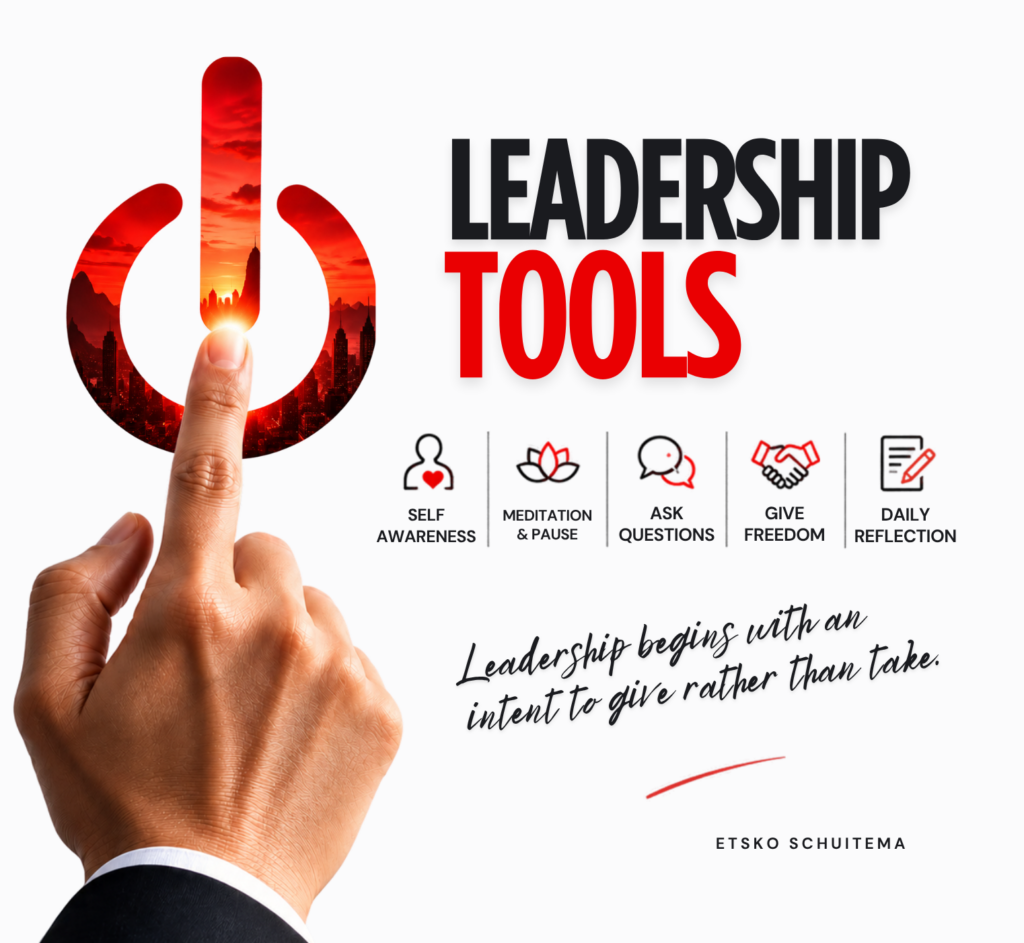
Across this five-part series, we will explore one tool in each article:
- REFLECT – What’s leading you?
Examine your reactions, identify the needs behind them, and look for patterns that reveal what drives you. - MEDITATE – Pause. Pay attention.
Use meditation and deliberate pauses to notice your thoughts and reactions before acting on them. - LISTEN – Set your agenda aside
Ask an open question, listen without preparing your answer, and check that you have understood. - LET GO – Less control. More autonomy.
Give people the means, ability and accountability to act, then progressively hand over decisions as they grow. - REVIEW – Examine your contribution
Review what you did, its effect on others and what you would change – then check whether you put that change into practice.
TOOL 1: REFLECT – What is actuall leading/driving you?
Knowing yourself begins with observing yourself when something is at stake. Start with three practices.
- Catch the disproportionate reaction.
When your response seems bigger than the event – anger because somebody is late, defensiveness when challenged, irritation when someone ignores your advice – examine the size of your reaction. Ask: Why did that bother me so much? What felt threatened? - Follow the need.
When you’re pushing hard for something, ask: What am I trying to get here? Go beyond the organisational answer to the personal one. Recognition? Control? Approval? Security? To be right?The answer may be uncomfortable. That’s precisely why the question is useful. - Look for repetition.
A blind spot rarely announces itself. It appears as a pattern. Why do I keep having the same conflict with different people? Why do I always take work back from others? Why does nobody challenge me in meetings? When the people change but the problem keeps returning, you may be the constant.
Self-awareness means catching yourself in the act – noticing your reactions, examining your needs and recognising the patterns that follow you from one leadership situation to another. Blind spots are called blind spots for a reason. You are usually the last person to see them. Try catching yourself this month. What did you notice, and how hard was it to admit? Do leadership and big egos always go together?
Let us know – we’d love to hear your experience.
Next in Leadership Tools 2026: MEDITATE – Who’s in charge: you, or the voice in your head?
Learn to notice it without letting it decide your next move.